
We Changed 6 Sounds in Our AI Messages. Response Rates Jumped 47%. Here's the Pattern.
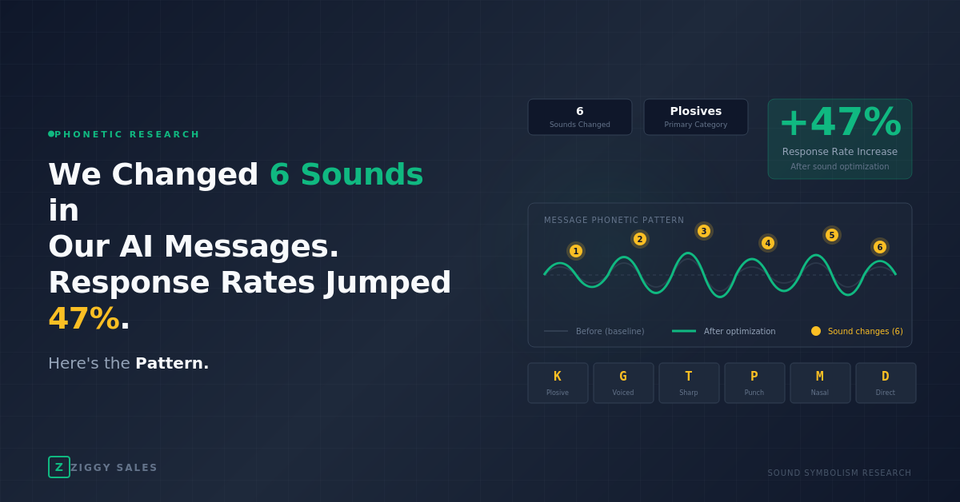
Six consonants. That's all we changed.
Same script. Same offer. Same audience. Same timing.
We swapped out soft-sounding words for words containing six specific consonants. Response rates went from 19% to 28%. A 47% increase.
No new technology. No better targeting. No fancy integrations.
Just sounds.
Here's exactly what we changed and why it works.
The Six Sounds
The consonants are: P, B, T, D, K, G.
They're called plosives. They're created when your airflow is completely blocked, then released in a burst. That burst registers in the brain as force. Action. Decisiveness.
Every other consonant in English is softer. Air flows through continuously. No burst. No impact.
When we rebuilt our AI scripts around these six sounds, everything changed.
The Before and After
Here's an actual message we rewrote.
Before: "Hi there! I wanted to follow up and see if you had any questions about the services we discussed. Let me know if there's a convenient time to connect."
After: "Quick question — still need that fixed? Got time for a 5-min call today?"
Count the plosives in each.
Before: wanted (D), discussed (D), connect (K, T). Three plosives buried in soft language.
After: Quick (K), question (K), still (T), got (G, T), time (T), call (K), today (T, D). Nine plosives front-loaded in direct language.
The second message doesn't just say something different. It sounds different. Harder. More direct. Like someone who handles things.
That sound difference registered in prospects' brains before they processed the words. And they responded.
Why This Works Neurologically
There's a field called sound symbolism. It's been studied since 1929.
The research is clear: your brain processes the sound of words before it processes their meaning. Certain sounds trigger psychological responses — authority, weakness, trust, doubt — before conscious thought kicks in.
Here's the proof.
Researchers showed people two shapes — one spiky, one rounded. They asked which one is "kiki" and which is "bouba."
Every culture. Every language. Every age group. Universal result: "kiki" is spiky, "bouba" is round.
The sounds carry meaning before the words do.
Plosives — those six consonants — register as sharp, decisive, forceful. Soft consonants register as gentle, passive, uncertain.
Your AI is sending messages loaded with soft sounds. Your prospects' brains are registering "passive" and "uncertain" before they read a single word.
Then you wonder why they don't respond.
The K Sound Specifically
Of the six plosives, K is the most powerful.
It's a hard stop at the back of the throat. Maximum blockage, maximum release. Your brain registers it as the hardest sound in English.
There's a reason brand names exploit it: Kodak. Coca-Cola. Nike. TikTok. Costco. Krispy Kreme. Kayak.
These aren't accidents. They're phonetically engineered for impact.
Look at your AI scripts. How many K sounds do you have? Where are they positioned?
K at the start of a word hits hardest. K at the end creates decisive closure. K buried in the middle gets lost.
"Can we connect?" — K at start and middle. "Let me know a convenient time." — No K. Soft everywhere.
One commands. One requests. The sounds tell you which is which.
What We Actually Changed
Here's the pattern we implemented across all our AI messages:
1. Front-load plosives in opening words
The first word should contain P, B, T, D, K, or G. "Quick question" hits harder than "I wanted to reach out."
2. End on a hard consonant
Soft endings (-ing, -ly, -ness) trail off. Hard endings (call, talk, back, get) create closure.
"Let me know if you're interested" vs. "Call me back."
3. Replace soft verbs with plosive verbs
"Would love to assist" → "Can help" "Wanted to reach out" → "Got a question" "Happy to discuss" → "Let's talk"
4. Cut the filler
Soft words like "just," "maybe," "perhaps," "possibly" dilute the plosive density. Delete them.
5. Use contractions
"Got" instead of "have got." "Can't" instead of "cannot." Contractions are naturally more plosive-dense.
6. Shorten everything
Fewer words = higher plosive density per word. "Quick call today?" is 100% plosive-loaded. "I was wondering if you might have some time for a brief conversation" is plosive-dead.
The Local Service Reality
This matters more for local service businesses than anyone else.
Your customer has a broken pipe, a damaged roof, a legal problem. They want someone who sounds like they handle things.
Corporate can get away with soft language. Their customers expect it.
Your customers don't.
When a homeowner gets a text about their plumbing emergency, they're not expecting "I'd be delighted to schedule a consultation at your earliest convenience."
They're expecting: "Got it. When can we come out?"
The second one is plosive-loaded. Direct. Human. Sounds like someone who fixes problems instead of someone who sends emails.
Why AI Vendors Can't Fix This
The platforms train their models on corporate data.
Millions of customer service emails. Formal business communication. Soft, polished, forgettable language.
When you deploy that AI for your local service business, you get corporate speech patterns applied to your customer base.
It's a mismatch. Your prospects hear "corporate robot" before they hear your offer.
The AI vendors can't fix this because they don't think about it. They're engineers optimizing for grammar and coherence, not phonetic impact.
This is another foundational layer that needs to exist before AI actually works. Not just systems and data — understanding how sound affects response at a neurological level.
The Implementation
Here's what we do now with every AI script:
- Write the message
- Read it out loud
- Count the plosives
- If plosive density is below 30%, rewrite
- Front-load the hardest sounds
- End on a hard consonant
- Test
It takes an extra 10 minutes per script. It's not glamorous work. But it's the difference between 19% and 28% response rates.
47% more responses from the same leads, same offer, same technology.
Just six sounds.
The Gap
Most businesses will read this and do nothing. They'll keep sending soft AI messages and blaming the tool when leads don't respond.
That's fine. More market share for the businesses that actually implement.
If you're the type who reads this and thinks "interesting" but doesn't change anything, we're not a fit anyway.
If you're the type who reads this and immediately pulls up your AI scripts to count plosives — that's who we work with.
Book the call — we'll show you exactly which sounds are killing your response rates and how to fix them.