
The "Invisible Fracture" That Makes AI Worthless (And Nobody's Checking For It)
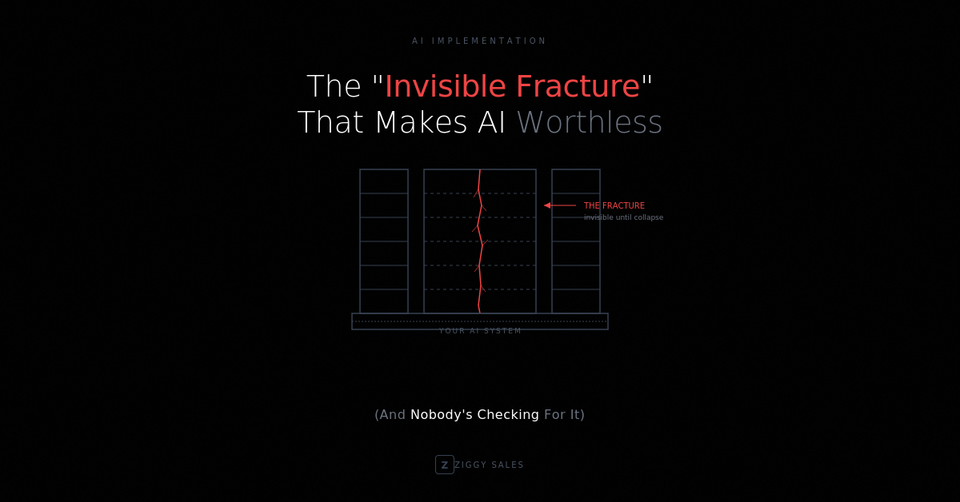
Everyone's talking about the wrong problem.
Last year, we ran an experiment. We took two identical businesses — same industry, same lead volume, same AI tools, same budget. One saw their conversion rates double. The other quietly turned everything off after 90 days.
Same technology. Opposite outcomes.
We spent six months figuring out why. What we found changed how we think about AI in sales entirely — and it has nothing to do with the AI itself.
Here's what nobody's telling you.
The Experiment That Broke Our Assumptions
When we started, we assumed the winning business had better prompts. Better integrations. Maybe they just "got" AI more than the other.
Wrong.
The difference had nothing to do with technology. It came down to something so basic, so boring, that most businesses skip right past it in their rush to automate.
The winning business knew exactly where their leads were dying. The losing business didn't.
That's it. That was the entire difference.
The Invisible Graveyard
Here's a question that will tell you everything: What happened to every lead that came in last month?
Not a guess. Not "most of them probably..." Actual names. Actual statuses. Actual outcomes.
If you can't answer that in 30 seconds, you have a visibility problem. And if you have a visibility problem, AI will only make it worse.
Why? Because AI amplifies whatever system it's plugged into. Plug it into a well-oiled machine, it accelerates results. Plug it into chaos, it accelerates chaos.
Most businesses are plugging AI into chaos — then blaming the AI when nothing works.
The Three Fractures
After analyzing dozens of failed AI implementations, we found the same three fractures every time:
Fracture #1: Speed
The average business responds to a lead in 47 hours. The data shows that responding within 5 minutes makes you 21 times more likely to qualify that lead.
Not 21% more likely. Twenty-one times.
AI can respond instantly — but if your underlying system doesn't track speed-to-lead, you'll never know if it's working. You'll have no baseline. No comparison. Just a vague sense that "something's happening."
Fracture #2: Persistence
Most sales teams quit after three follow-up attempts. Research shows conversion typically happens at touch eight or beyond.
AI can follow up forever — but if your system doesn't define what persistence looks like, your AI will either quit too early (mimicking your team's bad habits) or annoy prospects into oblivion (no rules, no limits).
Fracture #3: Visibility
If leads can exist in spreadsheets, sticky notes, text threads, and people's heads — your AI is only seeing a fraction of the picture. It's making decisions with incomplete data. It's following up on leads that were already closed. It's missing leads that never got entered.
Garbage in, garbage out. Except now the garbage moves faster.
The Question Nobody Asks
Before implementing AI, there's one question that predicts success better than any other:
Can you draw a map of exactly what happens to a lead from the moment it enters your system until it becomes a customer — or doesn't?
If you can draw that map, with specific stages, specific timelines, specific handoffs — AI will supercharge it.
If you can't draw that map, you don't need AI yet. You need the map.
This is what we learned from our experiment. The winning business had the map. They knew their speed benchmarks, their follow-up cadence, their stage definitions. AI just executed what they'd already designed.
The losing business had tools. They had enthusiasm. They had budget. But they didn't have the map. So they gave AI the keys to a car with no steering wheel.
Why This Matters More Than Ever
The AI hype cycle is creating a dangerous illusion: that technology solves problems it was never designed to solve.
AI doesn't fix broken systems. AI doesn't create process where none exists. AI doesn't magically know which leads matter and which don't — unless you've already defined that.
The businesses winning with AI right now aren't winning because they have better AI. They're winning because they did the boring work first. They built the system. Then they automated it.
Everyone else is trying to automate their way out of chaos. It doesn't work. It's never worked. And the companies selling you AI tools have no incentive to tell you that.
The Foundation Before the Future
We've stopped leading with AI. Not because AI doesn't work — it does, dramatically — but because most businesses aren't ready for it.
Ready means: you know where your leads die. You know your speed-to-lead. You know your follow-up cadence. You know your conversion stages.
Not ready means: you're guessing. And AI doesn't fix guessing. It just makes you guess faster.
If you're not sure which camp you're in, there's one way to find out. Ask yourself the question from earlier:
What happened to every lead that came in last month?
Your answer tells you whether you're ready for AI — or whether you need to build the foundation first.
We help businesses do both. Start with a system audit — we'll show you what needs to be true before AI can actually work.