
The Embarrassing Reason Most Businesses Aren't Ready for AI (It's Not What You Think)
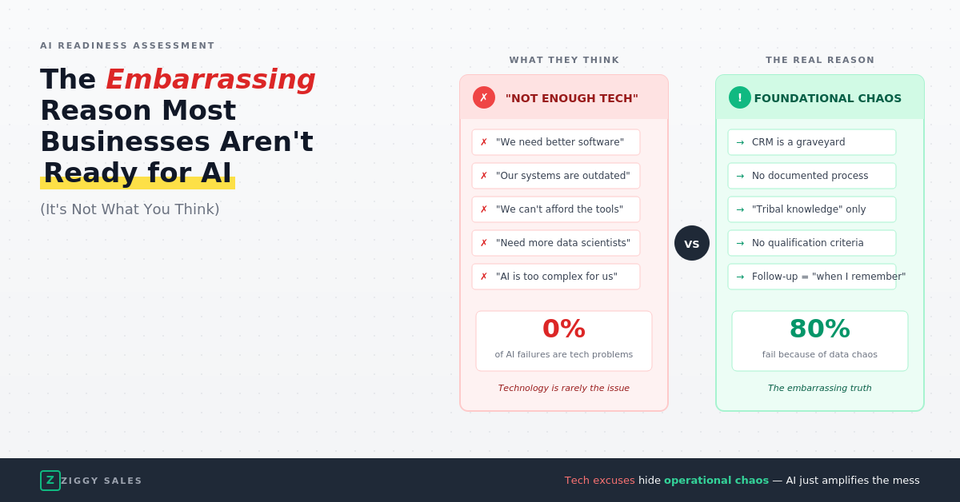
It wasn't the AI that failed. It was what came before.
A client came to us last quarter ready to deploy AI across their entire sales operation. They'd done the research. Compared the tools. Built the budget. They were ready to automate.
We told them to stop.
Not because AI wouldn't help them — it would. But because they were about to make a $47,000 mistake that we've seen destroy more AI implementations than bad technology ever has.
They were missing something so fundamental that every dollar they spent on AI would be wasted until they fixed it.
Here's what it was — and why it probably applies to you too.
The Question That Stopped Everything
When they walked us through their sales process, we asked one question:
"Show me where every lead lives right now."
What followed was ten minutes of "well, some are in this spreadsheet, and Sarah has a list, and there's a folder somewhere, and the newer ones are in our inbox..."
They had leads in seven different places. No single source of truth. No unified view. No way to know, at any moment, the status of any given opportunity.
And they wanted to plug AI into this.
Why AI Can't Save You From This
Here's what most people don't understand about AI in sales: AI needs memory to function. It needs to know what happened yesterday to make good decisions today.
Who was contacted? When? What did they say? What's the next step? How many times have we reached out? Are they hot, warm, or cold?
If that information lives in seven places — or worse, in people's heads — the AI is flying blind. It will follow up on leads that were already closed. It will miss leads that fell through the cracks. It will treat every conversation like it's starting from scratch.
You won't get automation. You'll get expensive chaos.
The client we stopped? They were about to spend $47,000 on AI implementation. Without a centralized system, that money would have evaporated in 90 days — burned on an AI that couldn't remember anything because there was nothing organized to remember.
The Unsexy Foundation
There's a reason nobody talks about this. It's boring.
"Centralize your lead data" doesn't make for a sexy headline. It doesn't promise 10x growth or revolutionary results. It's the business equivalent of "eat vegetables and exercise."
But here's the thing: the businesses crushing it with AI right now? They all did the boring work first. They all built the foundation before they built the automation.
That foundation has a name. It's called a CRM — and most businesses either don't have one or have one they're not actually using.
The Real Reason You Don't Have One
Let's be honest about why.
It's not the cost. Basic CRMs are cheap or free.
It's not the time. Setup takes days, not months.
It's what a CRM forces you to see.
A CRM shows you exactly how many leads came in. Exactly how many got followed up. Exactly how many died while everyone was "busy." It shows you the truth about your sales operation — and sometimes that truth is uncomfortable.
Without a CRM, you can hide behind stories. Leads are slow. The market is tough. We're doing our best.
With a CRM, the data speaks. And data doesn't protect feelings.
So people avoid it. They'll spend money on ads, on AI, on consultants — anything that feels like progress without the discomfort of actually looking at what's broken.
But here's the trap: AI makes this avoidance impossible. AI needs the data to exist. If you've been hiding from visibility, AI will expose you.
The Minimum Viable Foundation
You don't need Salesforce. You don't need HubSpot Enterprise. You don't need a six-month implementation.
You need three things:
1. One Source of Truth
Every lead goes into one place. Not some leads — every lead. If it doesn't exist in the system, it doesn't exist. This is non-negotiable for AI to work.
2. Defined Stages
What does "new" mean versus "contacted" versus "qualified"? If three people on your team would answer differently, you don't have stages. You have chaos with labels. AI needs clear stages to know what action to take.
3. Follow-Up Rules
How many times do you follow up? How long between attempts? When is something dead? These rules must be explicit — because AI will follow them literally. No rules means no logic. No logic means wasted automation.
That's the minimum. One place, defined stages, clear rules.
Everything else — the fancy integrations, the automation sequences, the AI-powered everything — builds on top of this. Without it, you're building on sand.
The Path Forward
When we stopped that client from making the $47,000 mistake, they weren't happy. They wanted AI. They wanted it now.
Six weeks later, they thanked us.
We spent those six weeks helping them build the foundation. Centralize the data. Define the stages. Document the rules. It wasn't exciting work. It wasn't innovative. But it was necessary.
When we finally turned on the AI, it worked. Not because we used better technology — because the technology had something real to work with.
The AI remembered every interaction because there was a system to remember. It followed the rules because the rules existed. It moved leads through stages because the stages were defined.
They didn't just get automation. They got automation that actually performed.
The Question You Need to Answer
Before you spend a dollar on AI, answer this:
If I asked you to show me every lead in your pipeline right now — their status, their last touchpoint, their next step — could you do it in under 60 seconds?
If yes, you're ready for AI. The foundation is there.
If no, you're not ready. And every dollar you spend on AI will be fighting against the chaos instead of amplifying a system.
The good news: building the foundation isn't hard. It's just not glamorous. And once it's built, AI becomes the accelerant it's supposed to be.
Not sure where you stand? Let's look at your system together — we'll tell you exactly what needs to be true before AI makes sense.