
Scientists Found Why Some Messages Stick and Others Disappear in 1.5 Seconds. The Answer Is Embarrassingly Simple.
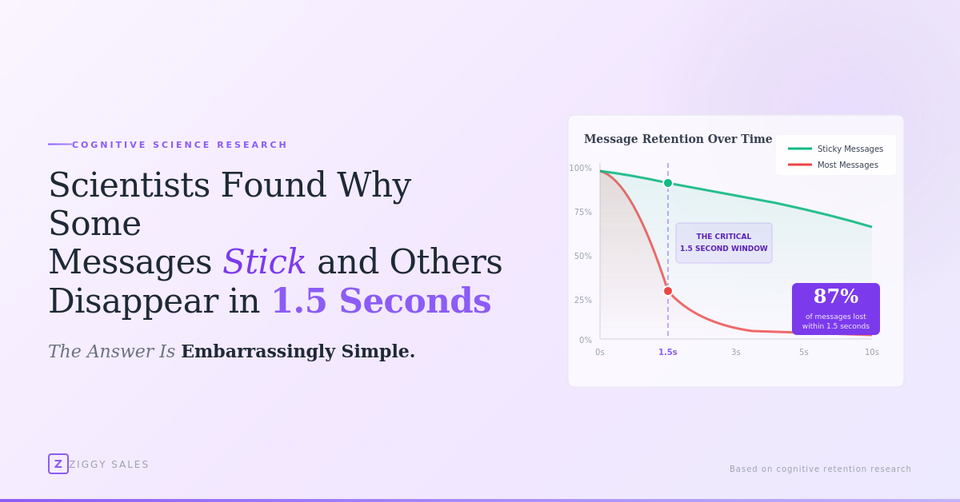
You have 1.5 seconds.
That's what the research shows. 1.5 seconds to make your message stick or watch it disappear forever.
Not 10 seconds. Not 5 seconds. 1.5.
In that window, your prospect's brain makes a decision: hold onto this or dump it. And scientists figured out exactly what determines which way it goes.
The answer is so simple it's almost embarrassing.
Pattern.
That's it. Pattern.
The Research Nobody Told You About
This has been studied since 1929. Cognitive scientists, linguists, memory researchers — they've known for almost a century why some phrases stick in your brain for decades while others evaporate before you finish reading them.
Your brain is pattern-recognition machinery. It evolved that way. Survival depended on recognizing patterns — predator movement, seasonal changes, social dynamics.
When language follows a pattern, your brain locks onto it. Encodes it. Holds it.
When language has no pattern, your brain processes it and dumps it. Gone in 1.5 seconds.
This isn't theory. It's neuroscience.
And your AI messages have zero pattern.
The Test That Proves It
Quick experiment.
Which of these will you remember 10 seconds from now?
A) "You should learn while you also earn money." B) "Earn while you learn."
Same meaning. One sticks. One doesn't.
B wins. Every time. Every audience. Every test.
Why? Pattern.
Internal rhyme: earn/learn. Parallel structure: verb-while-you-verb. Four syllables instead of nine.
Your brain catches it, holds it, encodes it. The other one? Gone before you finished this sentence.
This is the embarrassingly simple answer. Your messages aren't being ignored because of your offer, your timing, or your technology.
They're being ignored because they have no pattern for the brain to hold onto.
The 1.5-Second Window
Let's be specific about what happens in those 1.5 seconds.
Your prospect is driving. Walking. Scrolling. Half-paying attention to seventeen things.
Your message appears.
Their brain does a rapid scan: Is there a pattern here? Something to grab onto?
If yes: attention spikes, message gets processed, response becomes possible.
If no: dump it, move on, message functionally never existed.
This happens before conscious thought. Before they "decide" whether to respond. Before they read past the first few words.
Pattern or no pattern. Stick or disappear. 1.5 seconds.
The Patterns That Work
Scientists identified specific linguistic structures that create stickiness. This isn't creative opinion — it's research.
Internal Rhyme
Words that rhyme within the phrase.
"Earn while you learn." "Click it or ticket." "See the USA in your Chevrolet."
Rhyme is the single strongest predictor of memorability. Your brain loves pattern completion. Rhyme delivers it in real-time. Deeply satisfying at a neurological level.
Parallel Structure
Same grammatical pattern repeated.
"One place. One source. One system." "Your call. Your schedule. Your terms." "I came. I saw. I conquered."
Repetition creates expectation. Expectation creates attention. Attention beats the 1.5-second dump.
Isocolon
Clauses of equal length.
"We show. You grow." "We fix. You relax." "Buy one. Get one."
Equal length creates rhythm. Rhythm creates satisfaction. Satisfaction creates memory.
Three patterns. That's the whole answer.
Rhyme. Parallel structure. Equal length.
Embarrassingly simple. Exposed by 95 years of research. Ignored by every AI implementation I've ever reviewed.
Why Your AI Messages Are Forgettable
Pull up your last AI-generated message. I'll wait.
Now find the pattern.
Where's the rhyme? The parallel structure? The rhythmic repetition?
You won't find any. Because there isn't any.
What you'll find is something like:
"Hi! I wanted to follow up regarding your inquiry about our services. Please let me know if you have any questions or if there's a convenient time to connect."
Grammatically correct. Zero pattern. Neurologically dead on arrival.
Your prospect's brain scanned it in 1.5 seconds, found nothing to hold onto, and dumped it. They didn't "ignore" your message. Their brain physically couldn't retain it.
Now look at:
"Quick question — still need that fixed?"
Pattern: Question-dash-question. Parallel structure. Seven syllables. Something to grab.
It sticks. Not because it's better writing. Because it has pattern.
Why This Is Actually a Scandal
Here's what makes me angry about this.
The research exists. It's been public for 95 years. Any AI company could implement pattern structures into their language models.
None of them do.
They train on corporate data — emails, support tickets, formal communication. All pattern-free. All forgettable. All optimized for grammatical correctness instead of neurological impact.
Then they sell you this tool and act surprised when your messages get ignored.
The AI vendors aren't stupid. They just don't care about this layer. They're engineers solving engineering problems. Pattern density isn't in their metrics.
So you get AI that sounds "professional" and "polished" and disappears in 1.5 seconds flat.
The Local Service Difference
This matters more for local service businesses than anyone else.
Corporate sends emails to people sitting at desks. They have 30 seconds of attention. Maybe more.
You're texting someone whose basement is flooding. Someone whose AC died in August. Someone who just got rear-ended.
They're distracted. Stressed. Overwhelmed.
You don't have 30 seconds. You have 1.5.
In that window, your message either sticks or joins the pile of every other forgettable text they've received today.
Pattern is how you beat the window. Pattern is how you stick.
Your competitors sending "I'd be happy to assist you with your inquiry" are already gone. Dumped. Forgotten.
You sending "Got it. When works for a quick call?" — that sticks. That gets a response.
Same offer. Different pattern. Different result.
The Implementation
Here's how we build every AI script now:
Step 1: Write the message for clarity Step 2: Identify the core phrase Step 3: Rebuild with pattern — internal rhyme, parallel structure, or isocolon Step 4: Cut everything that isn't pattern Step 5: Test
Example rebuild:
"I wanted to follow up and see if you still have questions about our roofing services."
Core phrase: Do you still have questions?
Rebuild with parallel structure: "Quick question — still have questions?"
Rebuild with rhyme: "Checking in — still need that fix?"
Final: "Quick check — still need that fix?"
Seven words. Two patterns (parallel structure + internal rhyme). Sticks in 1.5 seconds.
It takes an extra five minutes per message. It's not sexy work. But it's the difference between messages that stick and messages that disappear.
The Uncomfortable Truth
The answer was always simple. Pattern.
That's what makes this embarrassing. We're not talking about advanced AI or sophisticated technology or cutting-edge research. We're talking about rhyme schemes. Parallel structure. The building blocks of language that poets have used for thousands of years.
Your AI ignores all of it.
And most businesses will read this, nod, and change nothing. They'll keep sending pattern-free messages and wondering why their "great scripts" aren't converting.
Fine. More market share for businesses willing to do the simple work.
1.5 seconds. Pattern or no pattern. Stick or disappear.
The science is clear. The fix is simple. The question is whether you'll implement it.
Book the call — we'll rebuild your AI messages with patterns that actually stick.