
Does Your AI Forget Your Prospect's Details by the Third Text? That's Not a Glitch. It's the Architecture.
Pt 2 of 7.
TLDR: What You'll Learn in 5 Minutes
Your AI's memory resets every time a conversation ends. That means every prospect who goes quiet and comes back is starting over. Your AI doesn't know who they are, what they said, or what matters to them. The relationship resets to zero. Every time.
- The average B2B sales cycle requires 8–12 touches. The average AI context window holds one conversation.
- Interpretation drift corrupts your prospect data silently: "50 employees" becomes "medium-sized team" becomes "small to mid-size business" across messages.
- Memory loss alone costs the average service business $12,000–$30,000/mo in deals that were warm and went cold because your AI couldn't remember them.
- Real memory requires dedicated agents: one for rolling summaries, one for structured fact extraction.
- Your action: Run the Telephone Test at the bottom. Send your AI specific details. See what survives after 6 messages.
Three Industries. Three Prospects. Three Conversations Your AI Already Forgot.
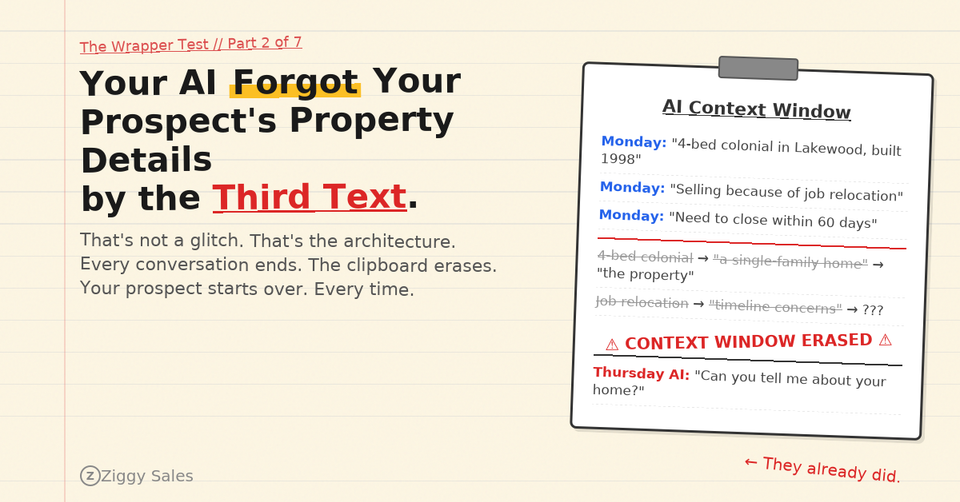
Real estate. A homeowner fills out a form and tells your AI they have a 4-bedroom colonial in Lakewood, built in 1998, selling because of a job relocation. A few messages go back and forth. Three days later they text: "What do you think we could list for?"
Your AI responds: "I'd be happy to help with a valuation! Can you tell me about your home?"
They already did.
Business insurance. A prospect spends ten minutes explaining that they run a 50-person manufacturing company, they have a clean claims history, and they're shopping because their renewal just jumped 22%. They go quiet for a week to compare quotes. They come back and ask about bundling workers' comp with their general liability.
Your AI responds: "Great question! Can you share some details about your business so I can help?"
They shared those details last Tuesday.
HVAC. A homeowner describes their 15-year-old Carrier system, says it's been short-cycling for three weeks, and they want to know whether it makes more sense to repair or replace. They disappear for four days while they talk it over with their spouse. They text back: "OK, we want to move forward with the replacement quote."
Your AI responds: "Thanks for reaching out! Tell me about your system and what's going on."
They told you. They told you everything. And your AI lost it.
What Forgotten Conversations Cost You
Memory loss isn't an inconvenience. It's revenue walking out the door, and the math compounds every month.
Real Estate Agent running $2,000/mo in Zillow ads:
- Average prospect goes quiet for 3–7 days between messages
- When they return and your AI asks them to repeat themselves, 60%+ stop responding entirely
- At a $12,000 average commission, losing just 2 warm prospects per month to memory resets: $24,000/mo gone
- Those weren't cold leads. They were people who already told you about their home.
Business Insurance Agency at $50 CPL, 200 leads monthly:
- Commercial insurance quotes take 1–3 weeks of back-and-forth
- Prospects who have to re-explain their business, headcount, and claims history don't come back
- At $1,200 per closed policy, losing 10 warm leads per month to forgotten context: $12,000/mo gone
- Your competitor's rep remembered. Your AI didn't.
HVAC Company running $3,000/mo in Google Local Services ads:
- Homeowners compare 2–3 estimates over 5–10 days before deciding
- When they come back ready to buy and your AI treats them like a stranger, they call the next company on their list
- At $8,500 per system install, losing just 3 ready-to-buy prospects per month: $25,500/mo gone
- These weren't tire-kickers. They came back to say yes, and your AI didn't know who they were.
Every one of these losses came from the same place: a prospect who was already warm, already engaged, already moving toward a decision. Your AI turned them back into a stranger.
Context Windows: The Clipboard That Erases
Here's why this keeps happening.
A context window is a clipboard. It holds the current conversation. When the conversation ends, the clipboard gets erased.
Every AI vendor talks about bigger context windows. More tokens. Longer conversations before things break. That sounds like progress, and it's irrelevant. A bigger clipboard is still a clipboard. It still gets erased.
The average real estate transaction takes weeks. Business insurance prospects compare 3–4 quotes over days. HVAC estimates sit in inboxes for a week before anyone decides. None of these fit inside a single conversation window.
So the question isn't whether your AI will forget. It's how much revenue disappears when it does.
The Telephone Game Inside Your Pipeline
Memory loss is bad enough. But there's something worse happening that you can't see.
It's called interpretation drift, and it's corrupting your prospect data silently.
A prospect texts: "We have about 50 employees and we're looking at a group health plan." Your AI processes that. By the next message, it's become "a medium-sized company interested in benefits." Two messages later: "a small to mid-size business exploring coverage options."
50 employees became "medium-sized" became "small to mid-size." Group health became "benefits" became "coverage options." Every paraphrase introduces drift. Over multiple touches, that drift compounds.
In real estate, the 4-bedroom colonial becomes "a single-family home" becomes "the property." In business insurance, "50-person manufacturing company" becomes "a mid-size business" becomes "a commercial client." In HVAC, "15-year-old Carrier that's short-cycling" becomes "an older unit with issues" becomes "your system."
The specific details that make a prospect feel heard dissolve into generic language that makes them feel processed.
This happens because wrappers interpret rather than extract. Extraction stores employee_count: ~50 as structured data. Interpretation rephrases it. One is data. The other is the start of a telephone game where the only player is your AI and the loser is your revenue.
The Damage You Can't Undo by Waiting
Here's the part that matters if you've been putting off evaluating your current system.
Every conversation your AI has today is either being stored as structured data or it's evaporating. There is no middle ground. And the conversations that evaporate don't come back.
That prospect who described their property in detail three weeks ago? That data is gone. The business owner who explained their claims history last month? Gone. The homeowner who told you exactly what system they have and what's wrong with it? Gone.
You're not just losing future conversations. You're losing the ones that already happened. And the longer your current system runs without real memory, the deeper the hole gets.
This isn't about rushing into a decision. It's about understanding that the status quo has a cost, and that cost is cumulative.
Take the Telephone Test
Try this right now with your AI system.
Send it this message:
"Hi, I'm Sarah. I have a 3-bed ranch in Maple Heights I'm looking to sell, and I need to close within 60 days because of a job relocation."
Have five or six messages back and forth. Then ask your AI to summarize what it knows about this lead.
If Sarah became "the client," if the 3-bed ranch became "your property," if 60 days became "a tight timeline," and if job relocation vanished entirely, you just watched your data corrode in real time.
That's not a bug. That's interpretation drift. And it's running on every conversation in your pipeline right now.
What Real Memory Looks Like
The fix isn't a bigger context window. It's a different architecture.
A dedicated Memory Agent creates rolling summaries as conversations advance. It compresses intelligently so critical details survive while filler gets trimmed. A Fact Extraction Agent stores "3-bed ranch, Maple Heights, 60-day close, job relocation" as structured data. Not interpreted. Not paraphrased. Stored.
When Sarah texts back Thursday, the system knows her name, her property, her timeline, and her motivation. When the insurance prospect returns after comparing quotes, the AI knows the 50-person headcount, the clean history, and the 22% premium hike. When the homeowner comes back ready to replace their Carrier system, the AI picks up exactly where they left off.
Not because it has a better clipboard. Because it has a different architecture entirely.

What's Next
Part 3 exposes the real reason 80% of AI fails, and it has nothing to do with technology. It's the reason your prospects ghost after three messages and can't explain why. Your AI is triggering something in their brain that kills trust before the conversation ever converts.
This is Part 2 of The Wrapper Test, a 7-part series on why your AI texting tools are failing and what the architectural fix looks like. New parts publish weekly.