
87% of People Can Spot AI Texting in 2 Messages. We Discovered the Hidden "Tell" and It Changes Everything
We ran a blind test. The results made us rethink everything.
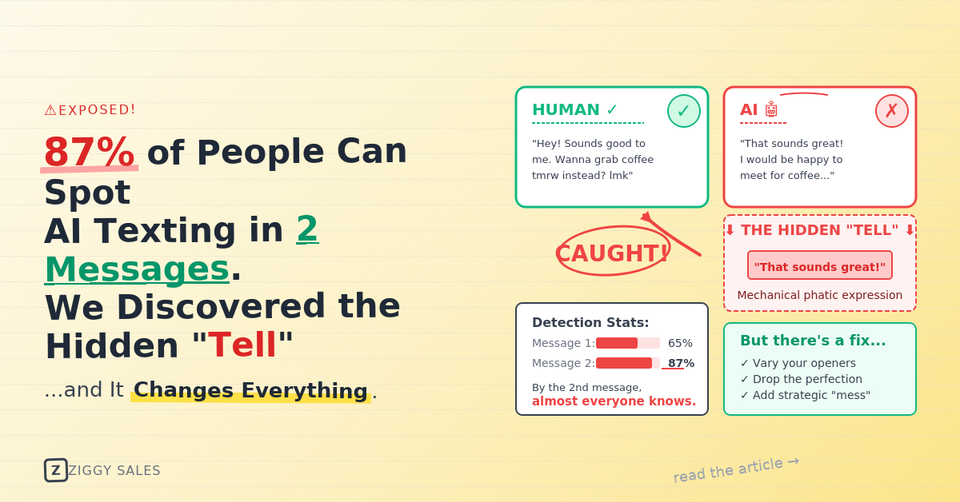
Last month, we showed 200 people two text conversations. Same script. Same information. Same goal. One was written by a human sales rep. One was written by AI.
We asked them one question: Which one is the bot?
87% got it right. In under 10 seconds.
But here's what made us rethink everything: when we asked how they knew, almost nobody could explain it. They just... felt it.
That "feeling" is costing businesses millions in lost conversions. And almost no one understands why — until now.
The Invisible Problem
When businesses deploy AI for texting — lead follow-up, appointment setting, customer engagement — they focus on what the AI says. The words. The information. The call to action.
That's the wrong focus.
What separates human from machine isn't what gets said. It's how it gets said. And that "how" operates at a level most people can't consciously identify.
We spent three months studying this. What we found explains why 80% of AI implementations fail — and it has nothing to do with the technology.
It has to do with linguistics. Specifically, a type of language that most AI gets catastrophically wrong.
The Word You've Never Heard
There's a term in linguistics: phatic language.
Phatic expressions are words and phrases that don't carry literal meaning — they carry social meaning. They're the "hey, how's it going?" and "sounds good!" and "haha yeah" of human conversation.
They don't communicate information. They communicate presence. They signal: "I'm here. I'm human. I'm engaged with you."
Humans use phatic language constantly in texting. It's so automatic we don't even notice we're doing it. But when it's missing — or when it's used wrong — something feels off. We can't explain it. We just feel it.
This is the tell. This is what 87% of people detected in under 10 seconds.
Most AI uses phatic language mechanically. It drops in the right words at the wrong moments. It says "I'd be happy to help!" when a human would say "yeah totally." It uses perfect grammar when humans use fragments. It responds instantly when humans pause.
The words are fine. The rhythm is wrong. And our brains, after millions of years of evolution, are exquisitely tuned to detect that wrongness — even when we can't articulate it.
The Uncanny Valley
You've heard of the uncanny valley in robotics — that unsettling feeling when something looks almost human but not quite. Your brain rejects it.
The same thing happens with AI texting.
When a bot responds instantly, never makes typos, uses perfect punctuation, and drops corporate phrases like "I'd be happy to assist you with that" — your prospect's subconscious sends a warning.
This isn't real. I'm being handled. I should disengage.
That disengagement happens before they consciously decide anything. The sale is dead before it started. And your dashboard just shows another lead that "went cold."
It didn't go cold. It got detected.
Why Every DIY Platform Gets This Wrong
Here's what the GoHighLevels and Manychats of the world don't tell you:
They let you control what the AI says. They don't let you control how it says it.
The behavioral layer — response timing, tone variation, punctuation patterns, phatic expression placement — is locked away in defaults that make every business sound identical. Sound identically robotic.
You can write the most human-sounding script in the world. The delivery will still betray you. Because delivery isn't about words. It's about patterns. And the patterns are fixed.
This is why 80% of AI implementations fail. Not because the technology is bad. Because the execution is generic. The AI knows what to say but doesn't know how to say it like your team would actually say it.
The Three Tells That Kill Conversions
Want to know if your AI is triggering the uncanny valley? Look for these patterns:
Tell #1: Timing Consistency
Humans don't respond in exactly the same time window every message. Sometimes fast. Sometimes slow. Sometimes we're mid-sentence when we hit send. Variation signals authenticity. Perfect consistency signals automation.
Tell #2: Grammar Matching
Real humans match the formality of whoever they're talking to. Casual prospect? Casual response. Professional prospect? Professional response. AI that uses corporate grammar with a casual prospect is immediately flagged.
Tell #3: Enthusiasm Without Specificity
"I'd love to help you with that!" sounds positive. It also sounds like something a call center agent says 400 times a day. Human enthusiasm references the actual conversation. "Oh nice, yeah that's actually a really common issue" hits different than generic positivity.
If your AI hits all three tells, your prospects check out before the conversation starts. Your data shows "unresponsive leads." The truth is: they responded to what they detected.
The Foundational Problem
Here's why this matters beyond just "better AI."
Most businesses skip straight to deploying AI without understanding how human communication actually works. They treat texting like email — information transfer. It's not. Texting is social performance. Every message carries subtext.
If you don't understand the linguistics of how your prospects communicate, your AI will be performing the wrong play. It'll be speaking French at an Italian opera. Technically communication. Totally wrong.
This is another foundational element that needs to exist before AI can work. Not just systems and data (though those matter too). Understanding of how your specific prospects actually text.
What's their average response length? How do they greet people? Do they use punctuation? Emojis? How formal is their industry? What phatic expressions are natural to them?
Without this understanding, you're not deploying AI. You're deploying an expensive machine that alienates everyone it touches.
What Actually Works
The solution isn't to abandon AI. It's to implement AI that's been built on a foundation of linguistic understanding.
This means:
- Variable response timing that mimics human patterns
- Tone matching that adapts to each conversation
- Phatic expressions placed naturally, not mechanically
- Strategic imperfection — grammar that matches context
It also means not using defaults. Ever. Your AI should sound like your team talking to your prospects. Not like every other chatbot trained on generic data.
This is custom work. It requires understanding both the technology and the psychology. And it's exactly why DIY platforms produce DIY results.
The Question Before You Deploy
Before you turn on any AI texting, ask yourself:
Could you describe, specifically, how your best sales rep texts differently than your worst one?
Not what they say. How they say it. The rhythm. The timing. The tone shifts. The way they build rapport before they pitch.
If you can describe that, you can teach AI to replicate it. If you can't, you're deploying AI without the most important input: what good actually looks like.
The businesses winning with AI aren't using better tools. They're building on better foundations. They understand their systems, their data, and their communication patterns before they automate any of it.
Everyone else is building robots that sound like robots — and wondering why their leads can tell.
Want to see what properly implemented AI texting looks like? Book a demo — we'll show you the difference linguistics makes.